
Table of Contents
- Why Hand Comfort Matters in Gardening
- Gardening Tools for Arthritis: What Changes Everything
- Ratchet Secateurs for Weak Hands: How They Work and Why They Matter
- Easy-Grip Garden Tools: Handle Design That Reduces Strain
- Long-Handled Garden Tools: Reducing Bending and Reaching
- Practical Testing Criteria: How to Choose Tools That Work for You
- Maintenance and Storage for Limited Dexterity
- Frequently Asked Questions
Last Updated: October 19, 2026
Why Hand Comfort Matters in Gardening
Gardening is rewarding for older Australians, but hand strain, joint pain, and reduced grip strength can make it painful. The best garden tools for older hands make it accessible again.
Hand and wrist comfort directly affects how long you can garden.
At Gardening Club Australia, we believe the right tools can transform gardening for our members.
This guide covers what matters when choosing best garden tools for older hands: handle design, ratcheting mechanisms, tool weight and length, and how to test tools before you buy.
Gardening Tools for Arthritis: What Changes Everything
Arthritis makes gripping, squeezing, and twisting painful. The best garden tools for arthritis reduce the force required and change how you hold the tool. But arthritis is not one condition: what suits osteoarthritis at the thumb base may not suit rheumatoid arthritis in the wrists and knuckles.
Match the tool to the movement that hurts
Start by identifying which movement causes pain, then choose the tool that removes it:
- Pain when squeezing (common with osteoarthritis at the base of the thumb): prioritise ratcheting secateurs, gear-assisted pruners, and trigger mechanisms that spread the cut across several light squeezes rather than one hard one.
- Pain when twisting (common with wrist arthritis): look for tools with rotating or swivel handles, and avoid auger-style weeders and bulb planters that require a full wrist rotation under load.
- Pain when gripping and carrying (common with rheumatoid arthritis affecting the knuckles): choose enlarged, soft-grip handles and tools light enough to carry one-handed, and use a holster or tool belt so you are not holding a tool while you work.
- Pain when pushing or levering (common with thumb-base arthritis): a long-handled fork or trowel lets you use body weight and a straighter wrist rather than a thumb-driven push.
Condition-specific adjustments
Osteoarthritis of the thumb base. The most common hand arthritis among gardeners, aggravated most by the pinch grip. Ratcheting secateurs with a finger-pull trigger are the single biggest upgrade.
Rheumatoid arthritis. Joints may be swollen and grip fluctuates day to day.
Tremor. Choose a slightly thicker handle (32-35mm) with a textured, non-slip surface.
Reduced sensation. Smooth plastic handles encourage over-gripping when you can’t feel your grip. Textured or padded grips give tactile feedback, and physical stops or locks prevent slipping when your grip relaxes.
What to look for in the handle
Enlarged handles, typically 30-35mm in diameter, let you hold the tool with your whole hand, spreading pressure and reducing grip intensity. Non-slip padded materials (rubber or foam) reduce tight gripping out of fear of slipping, and a soft, slightly compressible grip conforms to swollen joints rather than pressing on them.
Reduce the reach, not just the grip
Long-handled tools reduce bending, squatting, and overhead reaching, which strain shoulders, wrists, and hands. A hand cultivator with a 1-metre handle lets you work at waist height instead of crouching. For gardeners with shoulder or neck arthritis too, a long handle is often more valuable than any handle design feature.
If you are unsure which movement is causing the pain, spend one gardening session noting the moment your hand first aches, squeezing, twisting, carrying or pushing. That single observation will narrow your tool choice faster than any product description.
Ratchet Secateurs for Weak Hands: How They Work and Why They Matter
For weak hands, the advantage is clear: instead of one hard cut through a thick stem, you make multiple smaller squeezes, each requiring less force, with rest between pulls.
Ratchet secateurs typically weigh 200-250 grams, lighter than many manual pruners, and the cutting force comes from mechanical advantage, not your hand strength.
Look for models with:
- A comfortable trigger that doesn’t require a wide hand span to operate
- A locking mechanism that holds the blade closed (so you don’t have to grip it while carrying)
- Replaceable blades (so you’re not replacing the whole tool when it dulls)
Bypass pruners (two blades crossing like scissors) require significant grip strength and are generally not recommended for arthritis or weak hands.
Easy-Grip Garden Tools: Handle Design That Reduces Strain
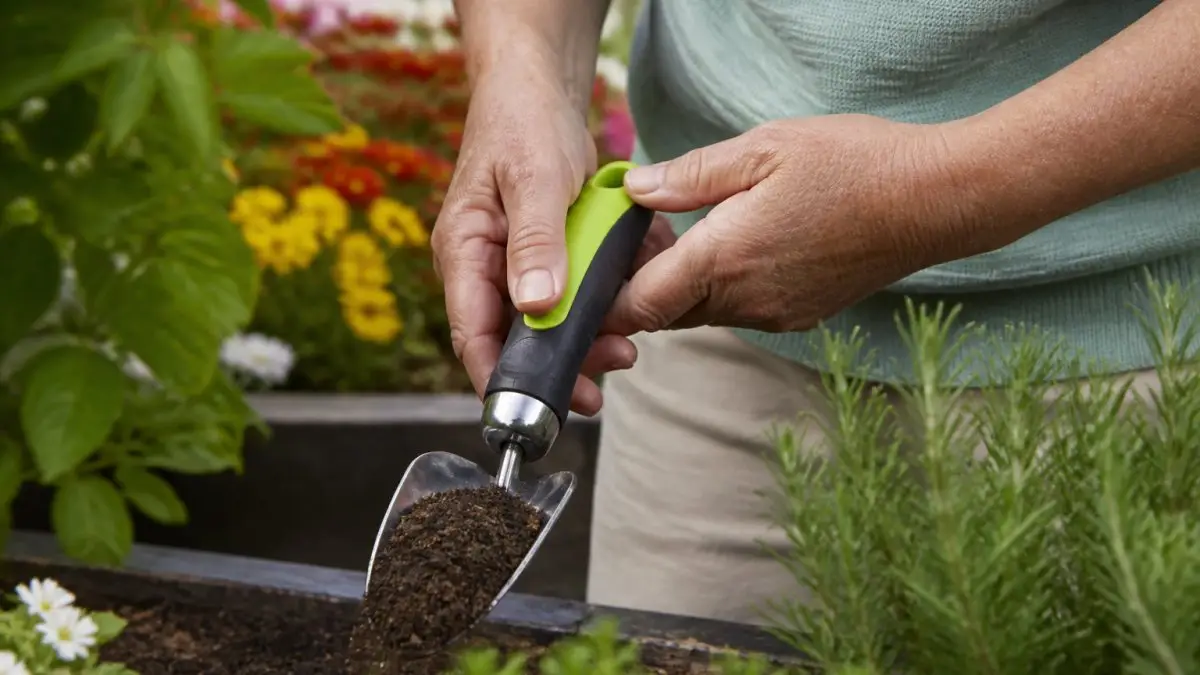
Handle design is where most gardening tools fail older users: a thin, hard plastic handle feels fine in a showroom but hurts after 10 minutes.
The best garden tools for older hands have handles that are:
- Padded or cushioned (rubber, foam, or cork) to reduce vibration and pressure points
- Enlarged (28-35mm diameter) so you can grip with your whole hand, not just your fingers
- Non-slip to reduce the tendency to grip tightly out of worry the tool will slip
- Textured to provide tactile feedback and control without requiring a death grip
Ergonomic handles are often angled to match your hand’s natural curve, reducing wrist strain compared to straight handles.
For tremor or reduced sensation, a slightly thicker handle (32-35mm) provides better control and stabilises your hand even if your grip isn’t as steady as it once was.
Test the handle by holding the tool for 2-3 minutes before buying.
Long-Handled Garden Tools: Reducing Bending and Reaching
Long-handled tools reduce strain on hands, wrists, shoulders, and back. A hand fork or trowel on a 1-metre handle lets you work at waist height instead of crouching.
The benefit isn’t just comfort but safety: prolonged crouching can cause dizziness, and rising from a crouch is risky with balance issues.
Common long-handled options include:
- Hand forks (for turning soil and breaking up clumps)
- Trowels (for planting and digging small holes)
- Cultivators (for loosening and aerating soil)
- Weeders (for removing weeds with minimal bending)
Lightweight aluminium or fibreglass is easier on your shoulders than wood for extended periods, and a padded top grip reduces hand fatigue.
Practical Testing Criteria: How to Choose Tools That Work for You
Before you buy, test the tool in your hand. These criteria turn vague ergonomic claims into things you can check in a garden centre or at home.
The six criteria that matter
Trigger force (for secateurs and pruners): Pull the trigger or squeeze the handle.
Handle diameter: Measure the handle or estimate by feel.
Weight: Hold the tool for 1-2 minutes with your arm extended.
Locking mechanism: Pruners and secateurs should lock closed so you can carry them safely without holding the trigger.
Handle texture: Run your thumb over the grip. It should feel slightly textured or padded, not smooth plastic.
| Testing Criterion | What to Check | Why It Matters |
|---|---|---|
| Trigger force | Can you operate it 20 times without fatigue? | Excessive force causes hand pain and limits how long you can work |
| Handle diameter | Is it 28-35mm? (roughly AA battery thickness) | Thin handles require tighter gripping and increase strain |
| Weight | Does it feel balanced and stable when held extended? | Heavy tools tire your hand and shoulder quickly |
| Wrist position | Is your wrist straight, not bent? | Bent wrists increase tendon and joint strain |
| Grip texture | Is it padded or textured, not smooth? | Smooth grips encourage tight gripping and reduce control |
| Locking mechanism | Does it lock closed with one hand? | Safety and convenience for carrying between tasks |
A short trial routine before you commit
You do not need a full afternoon in the garden to know whether a tool suits you. Try this sequence, ideally in the shop or with the tool still returnable:
- The two-minute hold. Hold the tool in your working grip for two minutes while standing. If your hand starts to ache or you find yourself re-gripping, the handle is wrong for you.
- The twenty-squeeze test. For secateurs, make twenty squeezes in the air. If the last five are noticeably harder than the first five, the spring or mechanism is too stiff.
- The dry run. At home, use the tool on a small, easy task, deadheading a few spent flowers, loosening a patch of bare soil, for no more than ten minutes. Stop at the first sign of ache rather than pushing through.
- The next-day check. The most useful test is how your hand feels the following morning. A tool that leaves you sore the next day is not the right tool, however comfortable it felt in the shop.
Buying guidance: budget, parts and trying before you buy
Comfort depends on the individual, so where you can, try before you buy. Many garden centres and specialist retailers let you handle tools in store, and some will let you return a tool that has been used lightly if it does not suit. Ask about the returns policy before you buy.
- Budget tiers. You do not need the most expensive tool to get a comfortable one. Entry-level ratcheting secateurs and long-handled hand tools are widely available, and the main features that matter, a padded handle, a light body, a one-hand lock, are not exclusive to premium models. Spend more where the mechanism does the work (ratcheting secateurs, geared pruners) and less on tools where a simple long handle is all you need.
- Replacement parts. Check whether blades and springs are replaceable. A tool with replaceable blades lasts longer and is easier to maintain if sharpening becomes difficult.
- Warranty. Look for a warranty that covers the mechanism, not just the handle, and keep the receipt.
The best test is not how the tool feels in the shop, but how your hand feels the next morning. Use the two-minute hold and twenty-squeeze test to shortlist, then confirm with a ten-minute dry run and a next-day check.
Many garden centres and specialist retailers let you try tools before buying. Take advantage of this. A tool that feels right in your hand is worth the extra effort to find.
Maintenance and Storage for Limited Dexterity
Tools with limited dexterity need to be easy to maintain and store.
Cleaning: Wipe blades with a dry cloth after each use. For stubborn sap, use a soft brush or cloth dampened with water.
Sharpening: Keep a simple sharpening stone or honing steel on hand.
Storage: Store tools in a dry place where you can reach them easily.
For tools with replaceable blades, keep spare blades on hand. When a blade dulls, swap it out rather than spending time sharpening.
At Gardening Club Australia, we believe gardening should be accessible to everyone. For just $5 a month, you can connect with experienced gardeners, access exclusive discounts on gardening supplies and tools, and share your own garden successes. Join us and discover how the right tools, and the right community, transform your gardening experience. Occupational Therapy Australia’s guidance on adaptive equipment for gardening
Frequently Asked Questions
What features should I look for in garden tools for weak hands?
Look for tools with padded or enlarged handles (25-32 mm diameter), lightweight construction under 500 grams, and low cutting force requirements. Ratcheting mechanisms reduce the grip strength needed for pruning. Non-slip, textured grips prevent slipping when hands are damp or trembling. Handles with ergonomic curves support your wrist in a neutral position. Test trigger force and locking mechanisms before buying, most good retailers let you handle tools first.
Are ratchet secateurs easier to use than standard secateurs?
Yes, for most people with reduced grip strength. Ratchet secateurs use a mechanical advantage system that requires multiple short squeezes rather than one strong grip. This distributes effort across your hand and reduces peak force needed. Standard bypass secateurs demand significant hand strength in a single motion. Anvil pruners (which crush rather than cut) require even more force. Ratcheting models are particularly helpful for arthritis or tremor, though they’re slower for heavy pruning work.
How can I make gardening easier on my hands and wrists?
Choose lightweight tools under 600 grams and use long-handled versions to reduce bending and upper-body strain. Take frequent breaks, work for 15-20 minutes, rest for 5. Warm your hands before gardening to improve flexibility. Wear padded gloves for grip and cushioning. Avoid repetitive motions in one direction; alternate hands or change tasks. Store tools within easy reach at waist height. If pain develops, stop immediately and ice if needed. Many gardeners find that adaptive accessories like tool grips or cuff supports make a real difference.
Are long-handled garden tools helpful for older gardeners?
Absolutely. Long-handled tools (typically 1-1.5 metres) let you work standing or with minimal bending, reducing strain on your back, hips, and knees. They’re especially valuable for digging, raking, and weeding. The downside is reduced control and precision for detailed work. Lightweight long-handled tools are essential, heavy ones tire your shoulders quickly. Many older gardeners use a mix: long-handled tools for bulk work, short-handled tools for precision tasks they do seated. Try before buying to ensure the length and weight suit your frame and strength.