Last Updated: October 28, 2026
Quick Summary
The best Aussie Gardener alternatives depend on your goal: Gardening Australia suits free expert advice, Hoselink suits watering equipment, and Gardening Club Australia suits community and member discounts. Free advice sites like Aussie Green Thumb and Minimalist Gardener are also worth bookmarking.
- Gardening Australia offers free, science-backed fact sheets, videos and regional planting guides.
- Hoselink is a specialist retailer for watering systems and hose equipment, from $29.90 AUD.
- Gardening Club Australia costs $5 per month (AUD) and offers member discounts and community sharing.
- Aussie Green Thumb provides independent, detailed tool reviews focused on price and practical use.
- Minimalist Gardener is best for native plants and low-maintenance, water-wise garden design.
Table of Contents
- How We Compared the Options
- Quick Comparison of Gardening Retailers and Resources
- Gardening Advice Websites Worth Bookmarking
- Gardening Tools and Supplies: Where Online Retailers Differ
- Online Gardening Communities and Who They Suit
- Small Balcony Garden Ideas for Limited Space
- Choosing the Right Alternative for Your Garden
- Frequently Asked Questions
Looking for the best Aussie Gardener alternatives is a sensible move for many Australians, whether you are a keen home gardener, a retiree on a fixed budget, or someone who simply wants more from an online gardening community. This guide compares gardening resources so you can decide what suits you.
Gardening is a popular pastime across the country, and the Australian gardening sector is sizeable. IBISWorld counts 18,362 gardening services businesses in Australia, growing at a compound annual rate of 6.0% between 2021 and 2026 (IBISWorld Australian Gardening Services industry report). That growth means plenty of choice, but also plenty of noise.
Many gardeners find that one retailer or website does not meet every need. Some want local climate advice, some want a place to share photos and ask questions, and others mainly want to save money on supplies and fuel. A single source rarely covers all three well.
The sections below explain how we compared the options, then look at retailers, advice websites, tool suppliers and online communities. Each section ends with practical guidance on who the option suits best.
How We Compared the Options
We judged each option against the same practical questions. Does it give useful, climate-specific advice? Does it help with tools and supplies? Does it offer genuine social connection? And what does it cost to use?
We focused on what each resource states it offers, rather than on promotional claims. Where information was unclear or unverified, we have said so instead of guessing. Readers should check the club’s website for current membership terms and discounts.
A common mistake is comparing a free information site with a paid membership as if they do the same job. They do not. A free guide answers questions, while a community offers ongoing conversation and shared experience. Judge each option by the need it meets.
Quick Comparison of Gardening Retailers and Resources
The table below summarises the main options at a glance. Prices are shown only where the research supports them.
| Option | Type | Starting Price | Best For |
|---|---|---|---|
| Gardening Club Australia | Online community | $5/month (AUD) | Social connection and member discounts |
| Gardening Australia | Broadcaster advice hub | Free | Science-backed expert advice |
| Aussie Green Thumb | Review and guide site | Free | Independent tool reviews |
| Hoselink | Specialist retailer | From $29.90 (AUD) | Watering systems and hose equipment |
| Minimalist Gardener | Native plant resource | Free | Native and low-maintenance planting |
The table makes one thing clear: these options are not interchangeable. A retailer like Hoselink helps you buy equipment, while an information site helps you choose what to plant. Gardening Club Australia is an online community for gardeners.
Gardening Advice Websites Worth Bookmarking
Free advice sites are a good starting point for most gardeners. Gardening Australia offers an extensive library of fact sheets, step-by-step videos and regional planting guides. Its content is expert-led and free of product pushing, which many readers value.
Aussie Green Thumb suits gardeners who want to research tools before spending money. Its detailed comparative reviews focus on price and practical use. Minimalist Gardener is the better choice if you want native plants and water-wise design.
Best for: Gardeners who want reliable, free reference material.
Skip if: You want hands-on conversation with other gardeners rather than articles to read.
Gardening Tools and Supplies: Where Online Retailers Differ
Most top-ranking pages for this query are a single retailer’s own landing pages, so they cannot tell you how that retailer compares with anyone else. This section does the opposite: it sets out the practical criteria that actually separate online gardening retailers, then shows how the main options differ on each one. Treat it as a buying framework rather than a league table, because stock, freight and fees change often.
The five criteria that matter
- Range versus specialisation. A specialist watering retailer such as Hoselink concentrates on hoses, reels and connectors. A general retailer spreads across seeds, soil, pots, tools and plants but rarely leads on any single category. Neither is better in the abstract, it depends on whether you are solving one problem or stocking a whole garden.
- Freight cost and delivery area. Bulky items such as soil, compost and large pots are where freight quietly erodes the saving. Check whether the retailer charges by weight or by order value, whether it delivers to regional and remote postcodes, and whether heavy-item surcharges apply.
- Live stock accuracy. Online catalogues frequently show items that are back-ordered. Look for retailers that display stock status per item and give a dispatch estimate, not just a delivery estimate.
- Returns and warranty handling. Living plants, seeds and opened soil are commonly excluded from change-of-mind returns, while tools usually carry a manufacturer warranty. Read the returns policy before ordering anything perishable or bulky.
- Customer service channel. Check whether phone support exists and what its hours are.
How the main options differ
| Retailer type | Typical strength | Typical weakness | Best for |
|---|---|---|---|
| Specialist watering retailer (e.g. Hoselink) | Durable, patented fittings; focused range | Narrow catalogue; you still need other suppliers | Replacing failed hoses and reels |
| General online garden retailer | One-stop ordering; broad range | Freight on bulky goods; variable stock accuracy | Stocking a new garden in one order |
| Membership club with discounts (e.g. Gardening Club Australia) | Ongoing discounts across supplies, tools, groceries and fuel | No published fixed savings figure; value depends on spend | Gardeners who already buy regularly |
| Local nursery with online ordering | Plants suited to the local climate zone | Limited delivery radius; higher plant prices | Buying plants that must survive transit |
A practical way to compare before you buy
Build a short basket of the five items you actually need, for example a hose, a reel, a bag of soil, a pair of secateurs and a packet of seed, and price that identical basket at two or three retailers, including freight to your postcode.
Gardening Club Australia’s member discounts cover gardening supplies, tools, groceries and fuel. See the membership cost and what it includes. Check the current discount terms on the club’s website and compare them with your own regular purchases rather than with a hypothetical basket.
Best for: Gardeners who want to compare on delivered cost and service, not just shelf price.
Skip if: You need a single item urgently and a local supplier can supply it today.
Online Gardening Communities and Who They Suit
An online community is different from an information site. It offers people to talk to, photos to share and advice from experienced members.
Gardening Club Australia is a welcoming online community where members can showcase their gardens, exchange advice and take part in a member-get-member rewards programme. Explore what the community offers and who it is for.
Community membership is not for everyone. If you prefer to learn quietly from articles and videos, a free resource such as Gardening Australia may serve you better.
Best for: Gardeners who want friendship, shared advice and member discounts at a low monthly cost.
Skip if: You only want reference articles and have no interest in interacting with other members.
Small Balcony Garden Ideas for Limited Space
Small-space gardening is where generic advice fails fastest, because a balcony in a tropical climate and a balcony in an arid or cool-temperate climate present opposite problems.
Start with the constraints, not the plants
Before choosing a single plant, measure three things: the hours of direct sun the space receives, the load the balcony or structure can safely carry, and the wind exposure. Pots of wet soil are heavy, and a cluster of large containers on an upper-floor balcony is a structural question, not just a design one. If you rent or own in a strata scheme, check the by-laws on balcony drainage and what may be fixed to railings before drilling or clamping anything.
Match the planting to your climate zone
- Tropical and subtropical: Heat and humidity favour herbs such as basil, Thai basil and lemongrass, plus dwarf chillies and leafy greens in the cooler months. The main risks are fungal disease and root rot, so choose pots with generous drainage and avoid overcrowding. Afternoon shade is an advantage, not a compromise.
- Arid and semi-arid: Water loss is the limiting factor. Use larger pots (they dry out more slowly than small ones), mulch the surface, and group pots so they shade one another. Hardy herbs such as rosemary, thyme and oregano cope better than soft-leafed annuals. Self-watering containers earn their cost here.
- Temperate and cool: Frost and low winter light are the constraints. Choose dwarf tomatoes, lettuce, parsley and chives for the warm months, and move tender pots against a north-facing wall for warmth. In frost-prone areas, either bring pots under cover or accept a seasonal reset.
- Mediterranean-style climates: A long dry summer and a wet winter suit rosemary, lavender, sage and citrus in large pots, provided drainage is sharp.
Containers, watering and vertical space
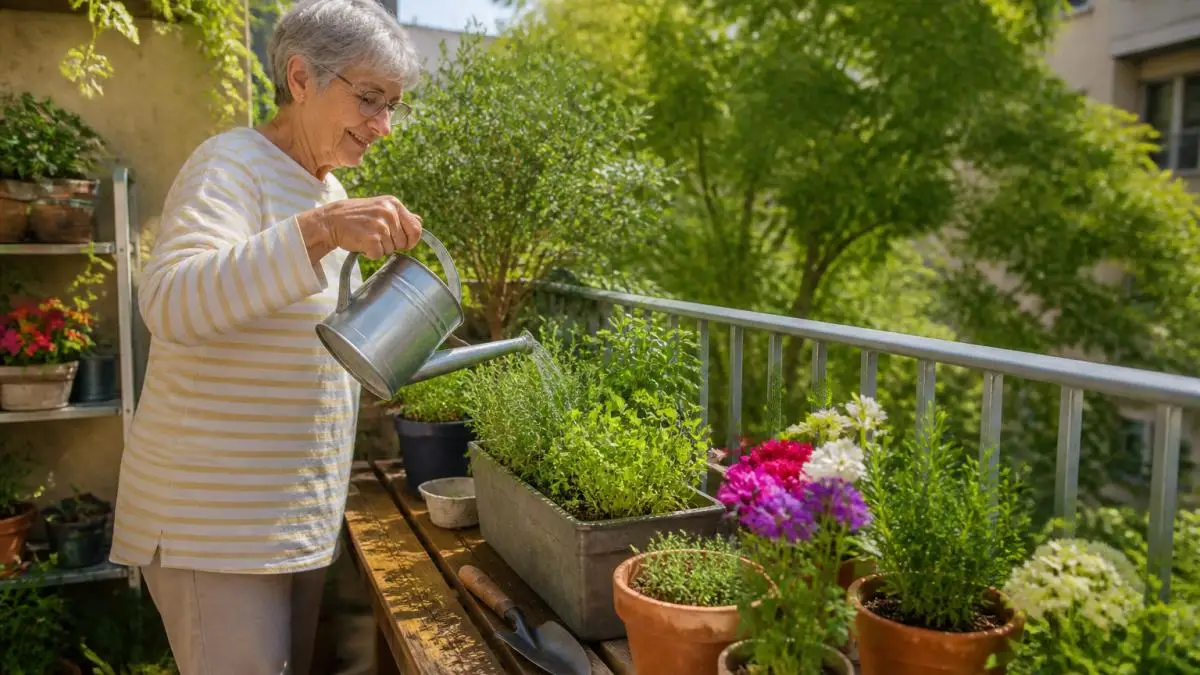
Choose containers with drainage holes and match pot size to the plant’s mature root spread, a dwarf tomato needs far more volume than a herb. Group pots by water need so you are not watering thirsty plants and drought-tolerant ones on the same schedule. A timber bench or shelf lifts pots to eye level, improves airflow and doubles the usable growing area without occupying more floor.
Balcony gardens dry out faster than ground beds, especially in wind. Check moisture daily in hot weather, water early in the morning, and use self-watering pots or a simple drip line if you travel. A saucer under each pot protects the balcony surface and the neighbours below.
Where the alternatives fit in
Small-space gardeners tend to need three different things, and no single option covers all three well. A free advice site such as Gardening Australia is the place to check regional planting guides and fact sheets before you buy. A specialist retailer such as Hoselink is the practical choice for a compact reel or drip fittings when hand-watering stops scaling.
Photograph your balcony at three times of day before planting. The sun map you build from those photos will tell you more about what will thrive than any plant label.
Best for: Renters and apartment gardeners who need zone-specific, space-limited advice.
Skip if: You have a full garden bed and can plant directly in the ground.
Choosing the Right Alternative for Your Garden
The right alternative depends on what you want from gardening. If you need trusted reference material, start with a free advice site. If you need specialist watering equipment, choose a retailer such as Hoselink. If you want community, shared knowledge and member discounts, Gardening Club Australia is an option.
Many gardeners combine resources. You might read Gardening Australia for planting guides, buy hoses from a specialist, and join an online community for friendship and advice. Start with the need that matters most to you, then add other resources as your garden grows.
Frequently Asked Questions
What are the best alternatives to Aussie Gardener?
The best alternative depends on what you need. Compare the options based on what you are looking for, and check each provider’s website for current information.
Where can I find reliable gardening advice online?
Gardening Club Australia members can exchange advice with experienced gardeners. You can also consult gardening resources online.
Are online gardening communities worth joining?
Gardening Club Australia is an online community where members can share garden photos and exchange advice with experienced gardeners. Members can access discounts on gardening supplies, tools, groceries and fuel. Check the club’s website for current membership information and discount terms.
Which websites offer gardening tips for beginners?
Beginners can use online gardening resources and ask questions in a gardening community.
Gardening Club Australia is an online community for gardeners across the country, with a $5 monthly membership that includes advice from experienced peers, a place to share your garden, and member discounts on supplies, groceries and fuel. Become a Member to start sharing your garden and joining the conversation.
