
Last Updated: November 1, 2026
Quick Summary
Gardening clubs for seniors in Australia are found through national bodies like Garden Clubs of Australia, which affiliates societies across the country. Start there, then check local council directories and community gardens, and always confirm meeting times and membership details directly with the club.
- Garden Clubs of Australia was formed in 1950 and affiliates societies nationwide.
- Ask the club secretary for the nearest affiliated society and whether they accept mid-year members.
- Treat online directories as leads and phone clubs to confirm they are still active.
- Ask whether you can attend one or two sessions as a guest before joining.
- Raised beds and long-handled tools reduce bending, kneeling and reaching.
Table of Contents
- Why Gardening Clubs Suit Older Australians
- Where to Find Gardening Clubs for Seniors Across Australia
- Community Gardens for Seniors: What to Expect
- Accessible Gardening Ideas for Members With Limited Mobility
- How to Start a Community Garden With Friends or Neighbours
- How to Evaluate a Club and Join Your First Group
- Booking Your Place in a Gardening Community
- Frequently Asked Questions
Why Gardening Clubs Suit Older Australians
Gardening clubs give older Australians a regular reason to leave the house and talk with people. A shared hobby often makes it easier to start conversations than a formal social event does.
Research into gardening and later life points the same way. A Scott et al. study on home and community gardening and older adults’ wellbeing examined how gardening links to psychosocial and physical wellbeing in older adults.
Gardening is also a practical activity. You learn by doing, you swap tips with others, and there is always something to plant, weed, or harvest. That makes it easy to join in, even if you are new to the hobby.
The benefits tend to show up in a few places:
- Social contact: regular meetings reduce time spent alone
- Physical activity: bending, digging and carrying keep you moving
- Purpose: tending plants gives each week a routine
- Shared knowledge: members pass on what grows well locally
Where to Find Gardening Clubs for Seniors Across Australia
Start with the national umbrella bodies, then work down to state and local listings. Because groups are run independently, contact details and meeting times change often, so always confirm directly before travelling.
National bodies and directories
Garden Clubs of Australia, the national umbrella body for garden clubs was formed in 1950 and affiliates societies across the country. Its member list is the single best starting point for a club near you; ask the secretary for the nearest affiliated society and whether they accept new members mid-year.
The [Australian Garden Calendar’s directory of garden clubs | australiangardencalendar.com.au] lists groups by state and region. Treat it as a lead generator rather than a verified register, phone or email the club to confirm it is still active, its meeting day, and whether visitors are welcome.
State and territory starting points
Use the state library, royal horticultural society, or council community-directory for your state as a second layer. In practice, the most reliable path is:
- Check the national affiliate list for your postcode or nearest town.
- Search your local council’s community groups directory for ‘garden club’ or ‘horticultural society’.
- Ask at a nearby community garden or men’s shed, members usually know which clubs are active.
- Call the club secretary and ask three questions: when do you meet, what does membership cost, and can I visit as a guest first?
What to ask before you travel
- Meeting format: in person, online, or hybrid?
- Meeting time: daytime, evening, weekday or weekend?
- Venue access: step-free entry, parking, seating, toilets?
- Cost: annual membership fee and any per-meeting charge?
- Trial: can you attend one or two sessions before joining?
Clubs in rural and regional areas often have smaller memberships and more flexible arrangements than city clubs. A phone call is usually more productive than an online form.
Online and low-mobility alternatives
If travel is difficult, an online group keeps you connected. Gardening Club Australia is an online community where members share photos, swap advice, and discuss what they are growing. book a place in the online gardening community to see how membership works. You can also follow state-based gardening Facebook groups and council-run garden newsletters, which often post workshop dates and volunteer days.
Community Gardens for Seniors: What to Expect
Community gardens are shared plots where people grow food and flowers together. Many have raised beds, which suit people who find bending difficult.
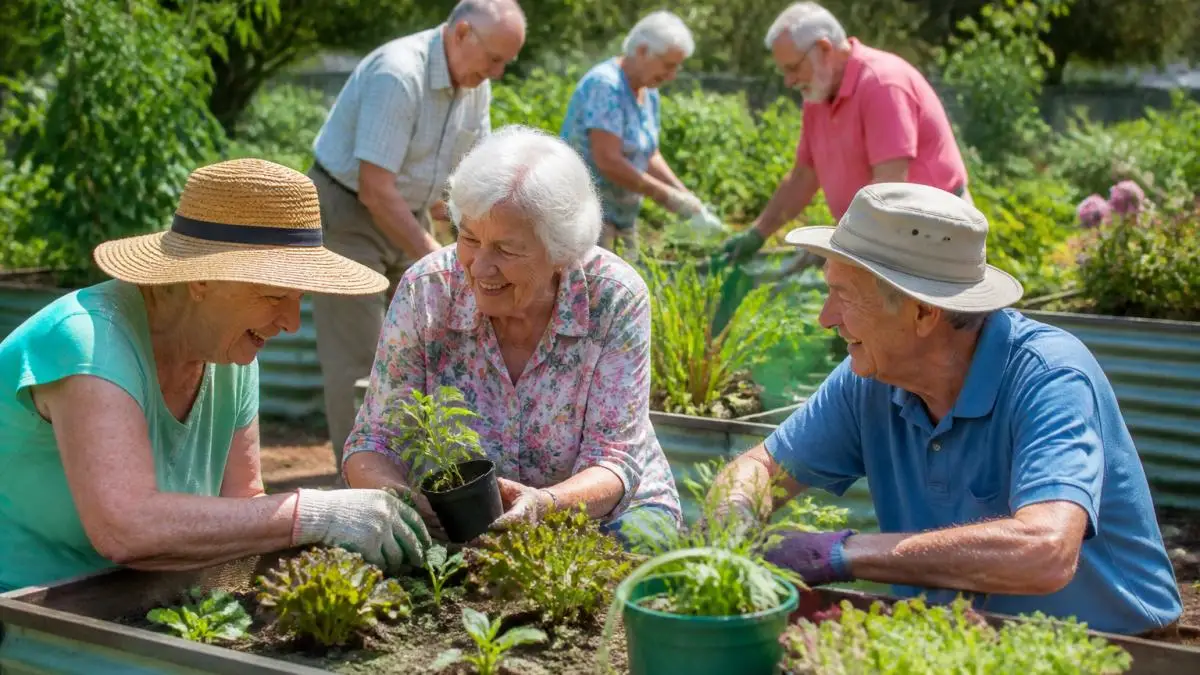
A typical visit involves working a plot, sharing tools, and taking home what you grow. Some gardens also run workshops and seasonal events. Plot availability and rules differ, so ask the local council or garden coordinator what is offered. Maintaining these communal spaces often requires physical effort, so understanding the scope of professional garden maintenance services can help ensure your chosen plot remains both productive and manageable.
A group of older gardeners working side by side in a sunny shared garden plot, tending raised beds and chatting, is a common scene at these gardens.
Accessible Gardening Ideas for Members With Limited Mobility
You do not need a large garden to garden well. Small changes can make the work easier.
- Raised beds: reduce bending and kneeling
- Long-handled tools: cut reaching and stooping
- Container planting: move pots to where you can reach them
- Seated work: use a stool or potting bench
- Vertical planters: grow herbs and salad greens at waist height
Many gardeners also keep indoor herbs or a few pots on a balcony. Gardening Club Australia members can share tips for what works in small or accessible spaces.
How to Start a Community Garden With Friends or Neighbours
A community garden can start small. A few neighbours and a shared patch of ground are enough to begin.
- Find a site: ask your council about vacant land or existing plots
- Gather people: invite friends, neighbours and local groups
- Agree on rules: decide on plot sizes, watering and shared costs
- Plan planting: choose crops that suit your climate and season
- Meet regularly: hold monthly sessions to keep the group active
Keep notes on what works. A simple shared record of planting dates and results helps new members learn fast.
How to Evaluate a Club and Join Your First Group
Most clubs welcome visitors, but the experience varies widely. Use this checklist to judge a group before you commit, and treat the first visit as a trial rather than a decision.
Accessibility and comfort
- Step-free access: is there a ramp or level entry, and are paths firm and wide enough for a walking frame or wheelchair?
- Seating: are there benches or chairs near the beds, and shade for rest breaks?
- Toilets: accessible facilities on site or nearby?
- Raised beds and tools: does the group provide raised beds, long-handled tools, or a potting bench at standing height?
- Transport: is there parking, a bus stop, or a member who can offer a lift?
Activity level and format
Ask whether the group is mainly social, mainly working bees, or a mix. A club that meets monthly for a speaker and a cuppa suits a casual gardener; a community garden with weekly watering rosters suits someone who wants regular outdoor work. Neither is better, match it to your energy and mobility.
Cost and eligibility
Membership fees vary from club to club and are usually set annually. Ask what the fee covers (insurance, venue hire, newsletters, seed swaps) and whether there is a concession rate. Community garden plots may carry a separate plot fee or bond; ask the garden coordinator. Check whether the club sets any age or physical-ability requirements for members.
Social atmosphere
Visit once and watch how newcomers are treated. A good sign is a greeter who introduces you to two or three members and explains the format. A warning sign is a clique that ignores visitors or a committee that cannot answer basic questions about insurance and first aid.
Your first-visit checklist
- Ring ahead and confirm the meeting is on.
- Arrive ten minutes early and introduce yourself to the secretary.
- Ask for a tour of the beds, shed, and facilities.
- Stay for the tea break, that is where the real conversation happens.
- Ask about the joining process and any waiting list.
A club that invites you to a second visit before you pay is usually a club with a healthy membership. Take the trial, then decide.
Gardening Club Australia offers membership with access to a friendly online community, advice from experienced gardeners, and member discounts. Check the website for current pricing and membership details before you sign up.
Before you commit, use this quick comparison of what to check at a club and why each point matters.
| Check | What to look for | Why it matters |
|---|---|---|
| Step-free access | Ramp or level entry, firm wide paths | Suits walking frames and wheelchairs |
| Seating | Benches near beds, shade for breaks | Allows rest during activity |
| Raised beds and tools | Standing-height beds, long-handled tools | Reduces bending and reaching |
| Activity format | Social, working bees, or a mix | Match to your energy and mobility |
| Membership cost | Annual fee and concession rate | Confirms what the fee covers |
| First visit | Greeter, tour, tea break | Shows how newcomers are treated |
Booking Your Place in a Gardening Community
If an online community suits you, the next step is simple. join Gardening Club Australia today to see the membership options, and start talking with other gardeners this week.
Frequently Asked Questions
How can seniors find a gardening club near them?
Start with the Garden Clubs of Australia network, which affiliates garden clubs and societies across the country. Search by state, then contact clubs directly to ask about meeting times, membership and whether they have members with limited mobility. Local council community centres and libraries also often list active groups nearby.
What activities do gardening clubs offer for older adults?
Most clubs run monthly meetings with speakers, plant swaps, seasonal planting days, and workshops on composting or pruning. Some host garden visits and social outings. Activities vary widely between groups, so ask what a typical month looks like before joining. Gardening Club Australia members can also share photos and advice with experienced peers online, which suits those who prefer to participate from home.
Are community gardens suitable for seniors with limited mobility?
Many community gardens now include raised beds, wide paths and seated work areas, but accessibility differs from site to site. Ask the coordinator whether plots are at waist height, whether there is level access and parking nearby, and whether tools are available to borrow. Some groups also offer roles such as watering or seed-saving that suit members who cannot kneel or carry heavy loads.
How can I start a gardening group for seniors?
Begin with two or three people who share your interest, then choose a regular meeting place such as a community hall, library or a member’s garden. Agree on a simple structure: a meeting schedule, a shared contact list and one rotating organiser. Contacting an existing club or your local council can also provide advice on insurance, venue hire and volunteer support.
