
Last Updated: November 15, 2026
Quick Summary
Older Australians can keep gardening with less strain by checking paths and safety first, choosing lightweight tools with wide grips, using raised beds at waist height, and pacing heavy jobs across the week with regular breaks. These gardening tips protect joints and backs while keeping the hobby enjoyable.
- Raised beds should sit between 75 and 90 centimetres high, with beds about 1.2 metres wide.
- Leave a clear path of at least 80 centimetres between garden beds.
- Choose tools that are light enough to use one-handed for several minutes without wrist strain.
- Garden early in the morning or later in the evening and shift heavy work to cooler days.
- Gardening for at least 150 minutes per week was associated with better mental wellbeing in a 2023 study.
Table of Contents
- Why Gardening Still Works for Older Australians
- Checking Your Garden for Access and Safety
- Choosing the Best Garden Tools for Older Hands
- Raised Garden Beds for Seniors: Setup and Height
- Low-Maintenance Garden Ideas for Less Bending
- Gardening With Limited Mobility: Task-by-Task Adaptations
- Pacing Your Gardening Week, Heat and Sun Protection
- Keep Gardening With a Community That Shares Your Interest
- Frequently Asked Questions
Why Gardening Still Works for Older Australians
Gardening is one of the few hobbies that gets better with age, and the research backs that up. A 2023 study published in Landscape and Urban Planning found that gardening for at least 150 minutes per week was associated with better mental wellbeing, and 2.5 hours per week with improved life satisfaction. Fjaestad et al., Associations of time spent gardening with mental wellbeing, Landscape and Urban Planning, 2023
Gardening keeps you moving, gets you outdoors, and gives you something to look forward to each day.
The best news is that you do not have to give it up because your body has changed. You only need to set things up so the work is easier on your joints and back.
Older gardeners who want to keep going usually need three things:
- Tools that fit the hand and reduce strain
- Beds and planting areas at a comfortable height
- A pace that suits the body, with regular breaks
The sections below cover each of these in turn.
Checking Your Garden for Access and Safety
Before you buy anything, walk your garden as if you were seeing it for the first time. Look for uneven paving, loose stepping stones, trailing hoses and steep slopes.
Start with a simple audit:
- Paths: Are they flat, firm and wide enough for a walker or wheelchair?
- Steps: Is there a handrail on every step?
- Lighting: Can you see where you are walking in early morning or evening?
- Seating: Is there a chair within easy reach so you can rest between tasks?
- Water: Is the tap and hose within reach without stretching or bending?
Fix the biggest hazards first. A loose paver or a hose lying across a path causes more falls than almost anything else.
Watch out: Do not climb a ladder or stool to reach high branches on your own. Ask a neighbour or a qualified tree worker for help instead.
Choosing the Best Garden Tools for Older Hands
Good tools make a real difference to comfort. Look for light weight, wide grips and long handles that keep your back upright, then check the details below before you spend money.
Weight. As a rough guide, a hand trowel should feel light enough to use one-handed for several minutes without your wrist tiring, and a long-handled tool should be light enough to lift and swing repeatedly without shoulder strain. Aluminium and fibreglass handles are usually lighter than solid timber or steel. If a tool feels heavy in the shop, it will feel heavier after twenty minutes in the garden.
Handle shape and grip. Padded or foam grips that are thick enough to hold without squeezing suit arthritic hands better than thin, hard handles. A grip diameter that lets your fingers wrap around with a small gap, rather than meeting the palm, reduces the force needed to hold the tool. D-shaped handles on spades and forks give a firm hold for digging; straight handles suit lighter work.
Reach and length. Long-handled weeders, hoes and fruit pickers let you work standing up. Adjustable-length handles are useful if several people share tools or if you want to use the same tool seated and standing. Check that the handle length lets you keep your back straight rather than stooping.
Mechanisms that reduce effort. Look for pruners and loppers that reduce hand strength, and check whether blades and springs can be replaced so the tool can be serviced rather than thrown away.
Setup and storage. Set tools up so they are easy to pick up and put down: store frequently used tools at waist height in a shed or rack rather than in a low box, keep a sturdy stool and kneeler where you use them, and hang long-handled tools by the handle so the blade is not resting on the floor. A tool belt or apron keeps pruners and twine within reach without bending.
Try a tool in the shop before buying. Hold it for a minute and check how your wrist and shoulder feel. If it aches, choose another.
Watch out: Do not buy a tool that is too heavy or too long on the assumption you will grow into it; an ill-fitting tool is more likely to cause strain than a lighter one you use comfortably.
Raised Garden Beds for Seniors: Setup and Height
Raised garden beds are one of the simplest ways to reduce bending, and they are among the most useful gardening tips for older growers. A bed at waist height lets you weed, plant and harvest while standing or sitting on a stool.
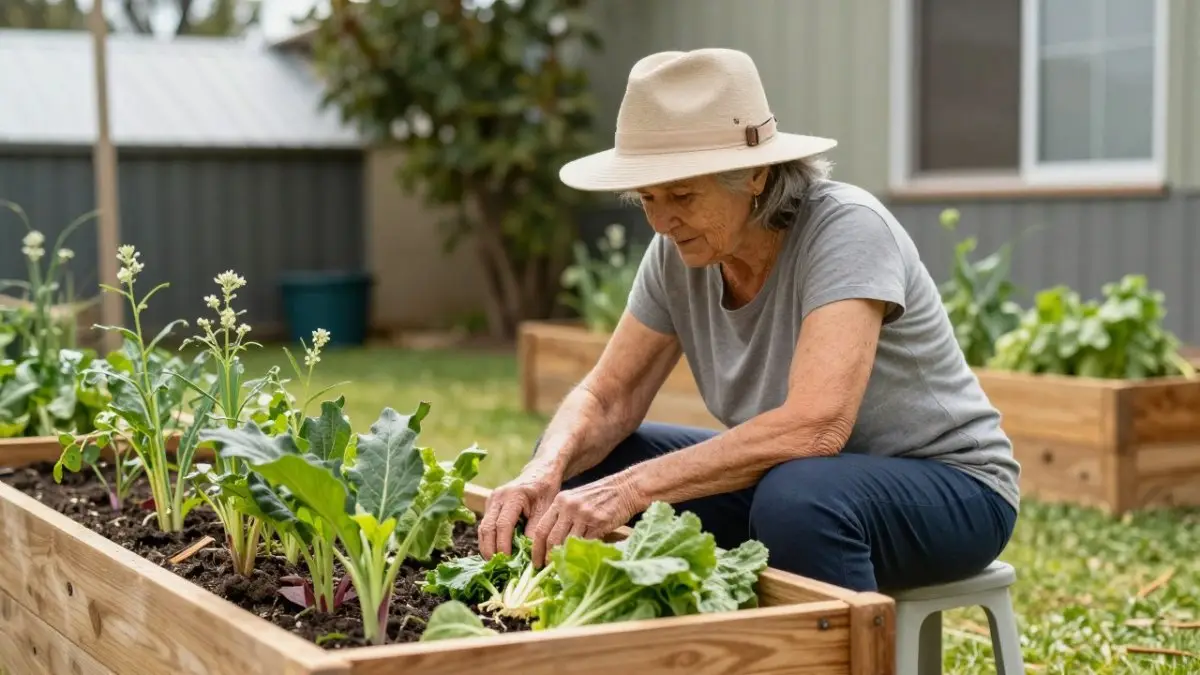
A good height for most people is between 75 and 90 centimetres. Measure your own comfortable height before you build or buy. Keep the bed narrow enough, about 1.2 metres wide, so you can reach the middle from either side.
Setup tips:
- Place beds on firm, level ground
- Leave a clear path of at least 80 centimetres between beds
- Fill with a mix of good topsoil and compost
- Add mulch to hold moisture and keep weeds down
Raised beds also suit container gardening. Pots on a sturdy table or bench give the same benefit with less soil to lift.
Low-Maintenance Garden Ideas for Less Bending
Plant choices affect how much work your garden needs. Choose plants that suit your climate, need little weeding, and grow at a manageable height.
Easy-to-grow edible options include:
- Onions and shallots, which need little attention once planted
- Broad beans, which grow tall enough to pick standing up
- Spinach and chard, which can be picked as you need them
- Carrots grown in deep containers, which avoids digging into hard ground
Ground covers and dense mulch reduce weeding. A thick layer of mulch keeps soil moist and blocks most weeds, which means less time on your knees.
Set up a watering system with a timer or drip hose. It cuts down on lugging watering cans and helps water go straight to the roots.
Gardening With Limited Mobility: Task-by-Task Adaptations
Each garden task can be adjusted to suit your body. Think about what each job asks of you, then change the method rather than pushing through the strain.
| Task | Common strain | Easier adaptation |
|---|---|---|
| Weeding | Bending and kneeling | Use a long-handled weeder or kneel on a foam pad |
| Planting | Digging and reaching | Plant in raised beds or pots at table height |
| Watering | Carrying heavy cans | Use a lightweight hose with a timer |
| Mowing | Pushing a heavy mower | Use a lightweight or battery mower |
| Harvesting | Stooping to pick | Grow crops at waist height |
If you have arthritis, a sore hip or balance problems, talk with your doctor or physiotherapist before starting a new routine. They can suggest movements that suit your condition.
Pacing Your Gardening Week, Heat and Sun Protection
Pacing matters as much as tools, and in Australian conditions it needs to flex with the season and your local climate. A common pattern is to spread heavy jobs across the week rather than doing them all in one day, and to take regular breaks.
A simple weekly rhythm. Rather than letting tasks pile up into one strenuous weekend, split them: one day for heavier work such as digging or moving soil, one or two days for light weeding and watering, and a day for harvesting and tidying. Keep a short written list so you can see what is due and stop before you overdo it.
Seasonal and climate adjustments. In hot, dry summers, garden early in the morning or later in the evening and shift heavy work to cooler days; in frost-prone areas, plan planting and pruning around the local frost window and protect tender plants rather than rushing out in cold, slippery conditions. In the wet season or humid months, watch for slippery paths and moss, and do lighter tasks in the shade. Coastal, inland and southern gardeners face different heat, wind and frost patterns, so check your local climate zone and adjust the schedule rather than following a generic calendar.
Heat and sun protection. Protect yourself from the sun and heat:
- Garden early in the morning or later in the evening
- Wear a wide-brimmed hat, long sleeves and sunscreen, and reapply through the day (UV protection for workplaces)
- Drink water before you feel thirsty and keep a bottle within reach
- Take a break in the shade when you start to feel tired
- Work on the shady side of the garden as the sun moves
Sit down, drink water and rest when you feel dizzy, short of breath or unusually hot. Those are signs to stop, not push on. If you take medication that affects hydration or heat tolerance, ask your doctor or pharmacist how to manage gardening in hot weather.
A seasonal maintenance plan. A simple plan helps you pace work and avoid tasks piling up: check watering, pick produce and do a light weed each week, tidy edges and check supports each month, and prune, mulch and plant according to your local climate each season. Write the plan down and treat rest days as part of the schedule, not a failure of it.
Keep Gardening With a Community That Shares Your Interest
Gardening is more enjoyable when you share it. Many older gardeners tell us they miss the chance to swap tips and talk about their plants. Gardening Club Australia gives members a place to do just that, with a friendly online community.
Members can share stories and photos of their gardens and exchange advice. If you want to meet people who enjoy the same hobby, you can read more about ways to meet gardening friends in Australia.
If you are ready to take the next step, join the Gardening Club community and start connecting with other gardeners today.
Frequently Asked Questions
How can older adults make gardening easier?
Start by simplifying the garden itself. Raised beds at waist height reduce bending, while low-maintenance planting such as perennials and mulched borders cuts down on weeding. Choose lightweight, long-handled tools with cushioned grips, and break tasks into short sessions of about 20 to 30 minutes followed by a 10-minute rest, a pacing guideline from the National Wildlife Federation. Working in the cooler morning or evening also reduces heat stress.
What are the best garden tools for older hands?
Look for lightweight tools with wide, padded or contoured grips that reduce the force needed to hold them. Long-handled weeders, cultivators and hand shovels let you work standing or seated rather than kneeling. Ergonomic pruners with a ratchet action can reduce hand strain. Test each tool in the shop before buying, checking the weight in your hand and how easily you can grip it for several minutes. Prices vary by retailer and model, so compare current prices directly.
How can I garden safely if I have limited mobility?
Begin with an accessibility check of your garden: clear level paths wide enough for a walker or wheelchair, add seating where you can rest, and keep frequently used tools and water within easy reach. Container gardening and raised beds placed at a height you can reach from a seat allow you to keep growing edible crops such as spinach, chard, shallots and broad beans. Pacing tasks, avoiding the hottest part of the day and wearing a wide-brimmed hat and sunscreen all help prevent strain and heat stress. If you need support, talk to your GP or an occupational therapist about adaptations that suit you.
Are raised garden beds easier for older people to use?
For many older gardeners, yes. A bed built to around 75 to 90 centimetres high lets you work standing or seated, avoiding repeated bending and kneeling that strains the back and knees. Keep beds no wider than about 1.2 metres so you can reach the centre without leaning over, and leave clear space around them for a mobility aid. Materials and build costs vary, so get current quotes from suppliers before committing.
