
Last Updated: October 25, 2026
Quick Summary
Social gardening groups are worth joining for older Australians because members report significantly more social and physical benefits than non-members, according to University of Queensland research on positive ageing and gardening. Groups range from community gardens and senior gardening clubs to free seed swaps, and most let you visit before committing.
- A Swinburne University of Technology survey found 94% of older Australians rate having gardening space where they live as extremely important.
- A typical senior gardening club meetup runs two to three hours and includes shared work, morning tea and a seedling swap table.
- Ask each group what the annual fee covers and whether a concession rate applies before you join.
- Visit two or three groups before committing, and be wary of any that pressure you to pay on day one.
- Break heavy jobs into 20-minute bursts and follow with a seated task like seed sorting or potting up.
Table of Contents
- Why Social Gardening Groups Suit Older Australians
- How Community Gardens Work and Who They Welcome
- Senior Gardening Clubs: What to Expect at a Meetup
- Accessible Gardening Tools for Older Adults
- Free Seeds and Seed Swaps: The Cheapest Way Into a Group
- How to Find and Join Social Gardening Groups Near You
- Costs, Safety and Staying Well in the Garden
- Join an Online Gardening Community Without Leaving Home
- Frequently Asked Questions
Why Social Gardening Groups Suit Older Australians
Gardening is one of the few hobbies that gives back twice: once in tomatoes, once in company. Social gardening groups for older Australians build on that double return, pairing time outdoors with regular contact with other people. This guide from Gardening Club Australia walks through what these groups are, how to find them, and what they cost.
The evidence is hard to argue with. A Swinburne University of Technology survey found that 94% of older Australians rate having gardening space where they live as extremely important. And a study of 331 Australian gardeners aged 60 to 95 found that group members reported significantly more social and physical benefits than non-members, according to University of Queensland research on positive ageing and gardening.
So what makes a group different from pottering alone in the backyard? Three things:
- Company on a schedule. A weekly meetup gives the week a shape.
- Shared know-how. Pests, soil, and seasons are easier to solve with five opinions.
- A reason to leave the house. That matters more than most people admit.
Below, we break down each type of group, what a meetup looks like, and how to pick one that fits.
How Community Gardens Work and Who They Welcome
A community garden is a shared growing space where members tend individual plots and common areas under a set of agreed rules. Most welcome anyone, from total beginners to seasoned growers, and many reserve plots or raised beds for older members.
The structure is usually simple. You pay a small annual fee, get a plot or a share of one, and chip in on shared jobs. Here is how the pieces fit together:
- Shared plots: individual beds or a section of a larger patch.
- Shared tools: spades, hoses, wheelbarrows kept in a communal shed.
- Shared jobs: watering rosters, compost turning, path upkeep.
Some gardens run waiting lists, so it pays to ask early. Others offer raised beds at waist height, which suits anyone with sore knees or a bad back.
Shared Plots, Shared Tools, Shared Jobs
The shared-jobs side is where the social part lives. A watering roster puts you in the same place at the same time as other people. That is how friendships start, and it is why community gardens are increasingly discussed as a local public health strategy, as noted in research on community gardens and social connectedness.
Community gardens run on a simple shared structure, and here is how the pieces fit together.
| Element | What it involves |
|---|---|
| Shared plots | Individual beds or a section of a larger patch |
| Shared tools | Spades, hoses, wheelbarrows kept in a communal shed |
| Shared jobs | Watering rosters, compost turning, path upkeep |
| Annual fee | Small fee for a plot or a share of one |
| Waiting lists | Some gardens run them, so ask early |
| Raised beds | Waist height, suits sore knees or bad backs |
Senior Gardening Clubs: What to Expect at a Meetup
A senior gardening club is a group that meets regularly to garden, swap advice, and socialise, often with older members as its core. Expect a relaxed morning, not a formal class.
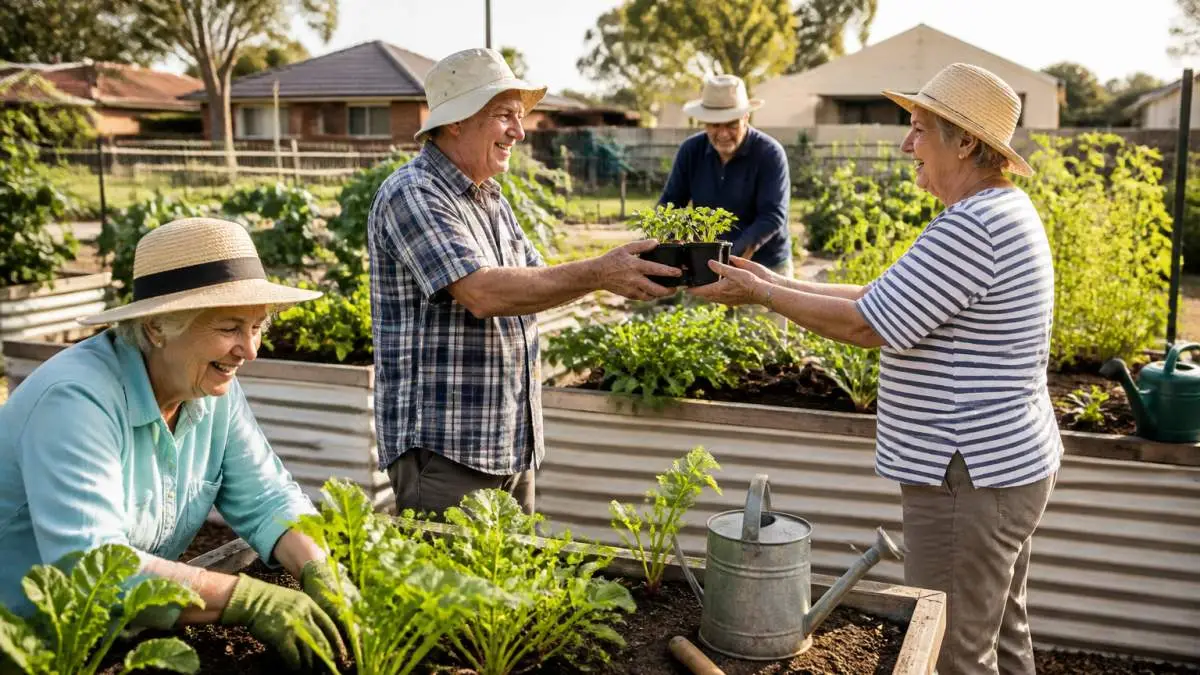
A typical meetup runs two to three hours and looks like this:
- A short welcome and a look at what needs doing.
- An hour or so of shared work: planting, pruning, weeding.
- Morning tea, which is often the real point of the day.
- A swap table for seedlings, cuttings, and surplus produce.
Some clubs also run guest talks on pruning or soil health. Others organise bus trips to open gardens. The tone varies a lot, so visit two or three before you commit.
Accessible Gardening Tools for Older Adults
Accessible gardening tools are designed to reduce bending, gripping, and lifting, and they make a real difference for anyone with arthritis, reduced strength, or limited mobility. The right tools keep you gardening for years longer.
What to look for:
- Long-handled tools so you can stand upright while digging.
- Raised beds at roughly waist height to cut bending.
- Lightweight secateurs with ratchet action for weaker grips.
A common mistake is buying a whole new toolkit at once. Start with the two or three tools you use most, then add as you go.
Free Seeds and Seed Swaps: The Cheapest Way Into a Group
Free seeds and seed swaps are exactly what they sound like: members bring spare seed and take home something new, at no cost. They are often the easiest first step into a group, because you can turn up with a packet of tomato seed and leave with a dozen new acquaintances.
A seed swap usually involves:
- A table or box of labelled packets.
- A short chat about what grows well locally.
- No obligation to bring anything on your first visit.
Most swaps happen in autumn and spring, timed to planting season. Ask at your local library, community centre, or men’s shed, as many host them.
How to Find and Join Social Gardening Groups Near You
Finding social gardening groups near you comes down to asking in the right places, checking a few practical details before you join, and knowing what to expect on the first visit. Most directories online are patchy and heavily weighted toward one or two states, so treat any single list as a starting point rather than the final word.
Where to look, in order of usefulness
- Your local council website. Most councils publish a community garden register and a seniors activities calendar. Search the council name plus “community garden” and “seniors”.
- Community centres and neighbourhood houses. These often host gardening meetups, seed swaps, and men’s sheds with a garden plot.
- Libraries. Many run seed libraries and gardening talks, and staff usually know which local groups are active.
- Neighbourhood noticeboards. Still effective, especially in regional areas where online listings are thin.
- Online communities. Useful for remote members or anyone testing the waters before committing to a weekly meetup.
What to ask before you join
A short phone call or email to the group contact will save you a wasted trip. Ask:
- What are the fees, and what do they cover (plot, insurance, tools, morning tea)?
- Are there raised beds, accessible paths, seating, and a toilet on site?
- What days and times do members meet, and is attendance flexible?
What a first visit usually looks like
Most groups expect you to visit once or twice before committing. A common pattern is a short welcome, a walk around the site, an introduction to two or three members, and an invitation to join the morning tea. You are not usually asked to bring tools or pay on the first visit. If a group pressures you to pay or sign anything on day one, that is a signal to look elsewhere.
A note on coverage
Listings for social gardening groups are uneven across the country. Capital-city and coastal areas tend to have more options, while regional and remote areas rely more on council-run programs, men’s sheds, and informal meetups.
You can also check local gardeners in your area to see who is active nearby. When you are ready to commit, you can join Gardening Club Australia and start connecting straight away.
Costs, Safety and Staying Well in the Garden
What groups actually cost
Costs vary widely, but a few patterns hold. Community gardens typically charge an annual membership fee per plot or per household, with concessions for seniors and health-care card holders at many council-run sites.
Rather than quote a single figure, ask each group three questions: what the annual fee is, what it covers, and whether a concession rate applies. Many councils also run community grants or subsidised plot schemes for older residents, worth asking about directly.
If cost is a barrier, ask whether the group offers a shared plot, a work-exchange arrangement, or a concession rate. Many do but do not advertise it.
Adapting the work to your ability
The most common mistake is doing too much on the first visit. A few habits reduce strain:
- Break heavy jobs into short bursts, 20 minutes of digging, then a sit-down task like seed sorting or potting up.
- Use long-handled tools and a seated stool so you are not bending or squatting for long periods.
- Lift with your legs, keep loads small, and ask for help with wheelbarrows or bags of soil.
If you have arthritis, a heart condition, or reduced balance, check with your GP before taking on heavier tasks, and tell the group organiser so they can pair you with suitable jobs.
Sun, heat, and the local environment
- Slip, slop, slap: hat, sunscreen, long sleeves, and sunglasses.
- Hydrate before you feel thirsty, and take water to the plot.
- Avoid the middle of the day in summer; early morning is cooler and often when groups meet.
Insurance and shared tools
Ask whether the group carries public liability insurance and whether members are covered while gardening. Most established community gardens do; informal meetups may not. Shared tools are convenient but check they are in good repair before use, and report anything broken.
For advice matched to where you live, see our guide to gardening across every Australian climate. Cost-conscious members can also review the member discounts on supplies and tools that help offset the cost of gardening.
Join an Online Gardening Community Without Leaving Home
An online gardening community is a group that meets through a website or app rather than in person, which suits anyone who cannot travel or prefers to start from home.
Gardening Club Australia runs one of these communities. Members share photos and stories, ask questions of experienced gardeners, and access discounts on supplies, tools, groceries, and fuel. There is no pressure to post, and no pressure to recruit anyone.
If you have been gardening alone since losing a partner, or you live somewhere remote, an online group can fill the gap until a local one opens up. You can browse the online gardening community to see how it works before you decide.
Frequently Asked Questions
How can older adults find a local gardening club?
Start with your local council, which often lists community gardens and seniors activities on its website. Neighbourhood houses, libraries and men’s sheds usually know what is running nearby, and community garden noticeboards advertise vacancies. For people in regional or isolated areas, online social gardening groups fill the gap when a physical club is too far away. Ask three things before committing: meeting days, whether raised beds are available, and what the membership fee covers.
Are community gardens suitable for beginners and older gardeners?
Yes. Most community gardens allocate raised beds at waist height, provide shared tools and water, and pair newcomers with experienced members. A University of Queensland study of 331 Australian gardeners aged 60 to 95 found that group members reported significantly more social and physical benefits than non-members, and most had started with little experience. Tell the coordinator about mobility limits, back problems or arthritis so they can assign a bed and tools that suit you.
What should I ask before joining a social gardening group?
Ask about fees and what they include, expected time commitment, whether tools and seeds are supplied, and how decisions are made if the garden is run by a committee. Check accessibility: paths, raised beds, toilets and shade. Confirm public liability cover and any working bee rules. If you are joining senior gardening clubs, ask how many members are retired and whether there is a buddy system for new people. A short visit on a working day tells you more than any brochure.
Do I need my own tools and seeds to take part?
Rarely. Community gardens and senior gardening clubs usually keep shared spades, forks, hoses and wheelbarrows, and many run seed swaps where members bring spare packets and take what they need for free. Accessible gardening tools for older adults, such as long-handled weeders, lightweight pruners and kneelers, are often available to borrow. If you prefer your own gear, buy one good tool at a time rather than a full set, and ask members what they actually use before spending.
Joining a group takes one phone call or one sign-up, and the first morning tea does the rest. If you want company in the garden without leaving your own patch, Gardening Club Australia offers a friendly online community, advice from experienced gardeners, and member discounts on supplies, tools, groceries, and fuel for $5 a month. Get started with Gardening Club Australia and grow your garden and your social circle at the same time.
