
Last Updated: November 17, 2026
Quick Summary
The best Australian plants for a low water garden include Grevillea, Lomandra longifolia, Westringia, Eremophila, Banksia integrifolia, Callistemon, grass trees and Gymea lilies. Match each plant to your soil, sun and climate, because drainage kills more natives than dry spells. Water deeply through the first one to two summers, then most survive on rainfall alone.
- Waterwise plants can cut garden water use by up to 50%, according to the South East Coastal Gardens Planting Guide.
- Space shrubs at roughly half their mature spread so they knit together without smothering each other.
- Plant Grevillea and Eremophila on raised mounds if your soil is heavy clay that holds water.
- A Westringia hedge reaching 1-2 m is usually planted at 60-80 cm centres for a dense screen.
- In summer, a pot in full sun may need water every two to three days.
Table of Contents
- Why a Low Water Garden Makes Sense
- The Best Drought Tolerant Australian Plants Compared
- 1. Grevillea: Nectar-Rich Colour With Almost No Water
- 2. Lomandra longifolia: The Grass That Refuses to Die
- 3. Westringia: Hardy Hedges for Wind and Salt
- 4. Eremophila, Banksia and Callistemon: Flowering Natives for Dry Beds
- 5. Groundcovers, Grass Trees and Gymea Lilies: Structure and Low Borders
- Low-Water Plants for Pots and Balconies
- Frequently Asked Questions
Why a Low Water Garden Makes Sense
Waterwise plants can cut garden water use by up to 50%, according to the South East Coastal Gardens Planting Guide. That is the single strongest argument for rethinking what goes in your beds.
Below, we walk through the best Australian plants for a low water garden, with honest notes on soil, spacing and what each one actually needs.
If you want advice tuned to your own patch, our members share gardening advice across every Australian climate. Older gardeners who want to keep pottering without the strain will also find gardening tips for less physical strain useful.
The Best Drought Tolerant Australian Plants Compared
The best drought tolerant Australian plants are those matched to your soil, sun and space, not simply the toughest species on a list. A plant labelled water-wise will still fail in heavy clay or deep shade.
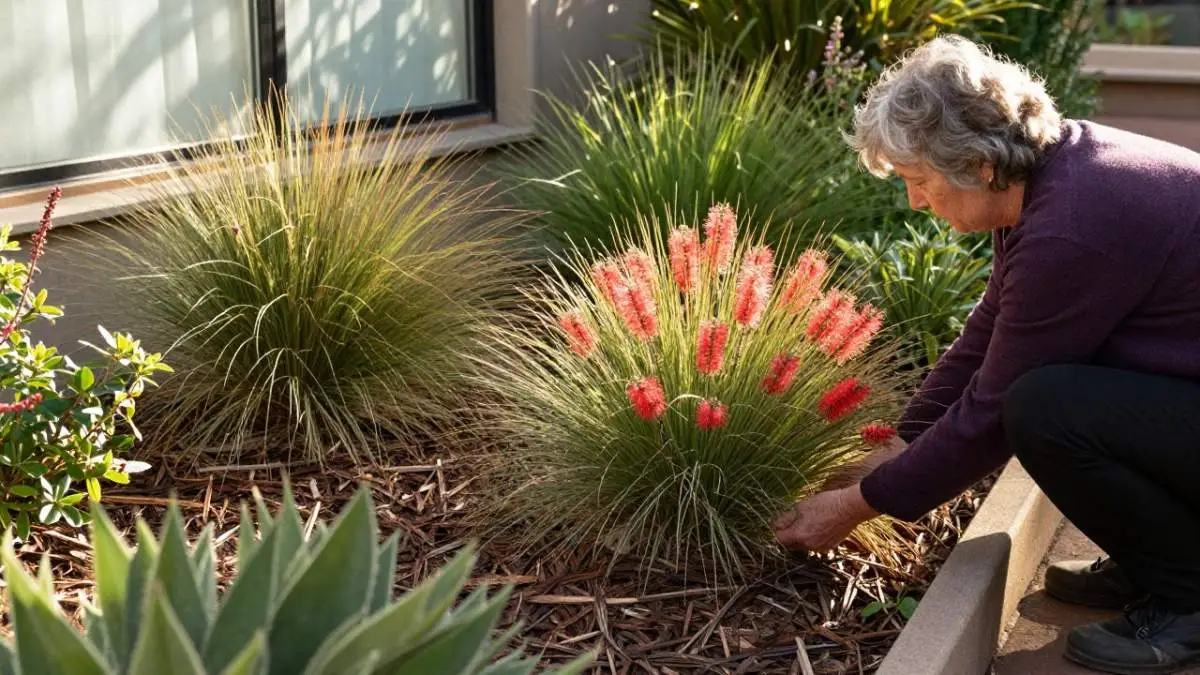
Quick Comparison: Water Needs, Sun and Mature Size
| Plant | Water After Establishment | Sun | Mature Size | Best For |
|---|---|---|---|---|
| Grevillea | Very low | Full sun | 0.5-3 m | Bird-attracting colour |
| Lomandra longifolia | Very low | Sun to part shade | 1 m x 1 m | Borders and mass planting |
| Westringia | Very low | Full sun | 1-2 m | Hedges and coastal wind |
| Eremophila | Very low | Full sun | 1-2.5 m | Hot, exposed beds |
| Banksia integrifolia | Low | Full sun | 5-15 m | Screening and habitat |
| Callistemon | Low | Full sun | 1-4 m | Spring colour |
| Grass tree | Almost none | Full sun | 1-3 m | Feature planting |
| Gymea lily | Very low | Sun to part shade | 2-3 m | Bold focal point |
Match the Plant to Your Climate Zone, Not Just the Label
Most plant guides list drought-tolerant species without telling you which climate they actually suit. That is the gap that costs gardeners money. A plant that thrives on rainfall alone in a hot, dry inland garden can rot in a humid coastal garden, and a species that shrugs off salt spray on an exposed coast may sulk in a frost hollow.
- Hot, dry inland and semi-arid: Eremophila, grass trees and most Grevillea cultivars are the safest core. They want full sun, sharp drainage and room to spread. Banksia integrifolia is tougher than it looks but prefers sandy ground over heavy clay.
- Warm humid coastal and subtropical: Westringia, Callistemon and Lomandra longifolia handle humidity and salt better than most. Eremophila often struggles in humid summers, so treat it as a gamble rather than a staple.
- Temperate and cool-climate gardens: Lomandra longifolia takes frost, Westringia clips into a reliable hedge, and many Grevillea species cope with cool winters provided drainage is good. Gymea lily is slower in cool districts but still worth a sheltered spot.
- Mediterranean-style climates with wet winters and dry summers: the critical issue is winter drainage, not summer heat. Raise beds for Eremophila and Grevillea, and lean on Banksia and Callistemon where soil stays heavier.
Soil, Drainage and Sun: The Conditions That Decide Survival
Drainage matters more than rainfall. Most native plant losses in low water gardens come from roots sitting in waterlogged soil through winter, not from a dry spell in February.
Sun exposure is the second filter. Grevillea, Westringia, Eremophila and Banksia want full sun and flower best with at least six hours a day. Lomandra and Gymea lily tolerate part shade but flower less.
Spacing and Planting Density
Crowding is the quiet killer of low water gardens. Plants that are spaced too closely compete for water and light, and the weakest ones fail in the first dry summer. As a working rule, space shrubs at roughly half their mature spread so they knit together without smothering each other. A Westringia hedge at 1-2 m mature size is usually planted at 60-80 cm centres for a dense screen; Lomandra tussocks at 1 m across are best at 60-80 cm centres for mass planting.
Water Needs After Establishment
Drought tolerance does not mean no watering. Almost every plant on this list needs regular deep watering through its first one to two summers while roots establish. After that, most survive on rainfall in average years, but they perform better with an occasional deep soak during extended dry spells. The table above separates very low from low water needs for that reason: Banksia and Callistemon are reliable but appreciate a summer drink, while grass trees and established Eremophila genuinely need almost nothing.
1. Grevillea: Nectar-Rich Colour With Almost No Water
Grevillea is the first pick for most dry gardens because it flowers hard, feeds the birds and asks for very little once established.
Two things decide whether a Grevillea lives or dies. It wants full sun and freely draining soil, and most varieties resent phosphorus-heavy fertiliser. Watch out: planting a Grevillea into boggy clay without raising the bed is the most common way gardeners lose one.
Best for: wildlife-friendly colour in a sunny bed.
Skip if: your soil stays wet through winter.
2. Lomandra longifolia: The Grass That Refuses to Die
Lomandra longifolia is the toughest plant on this list and the one we recommend first to anyone who wants a low-maintenance garden.
The one drawback is that old clumps can grow thick and woody in the centre. Lift and divide them every few years to keep the foliage fresh.
Best for: borders, erosion control and gardeners who travel.
Skip if: you want flowers as the main event.
3. Westringia: Hardy Hedges for Wind and Salt
Westringia, or native rosemary, is the shrub to reach for when you need structure in a harsh spot.
It does need regular trimming to stay dense. Left alone, it opens up in the middle. Coastal gardeners get the best results from it of any hedging native.
Best for: coastal gardens and formal low hedges.
Skip if: you will not prune it at least once a year.
4. Eremophila, Banksia and Callistemon: Flowering Natives for Dry Beds
Eremophila, Banksia and Callistemon can cover the middle and back of a dry bed, and each brings something different. Eremophila, the emu bush, handles the hottest, most exposed sites and draws honeyeaters with tubular flowers. Banksia integrifolia makes a long-lived screen that tolerates poor sandy soil.
All three demand sharp drainage. Eremophila in particular will rot in soil that holds water, so plant it on a raised mound if your ground is heavy. The Australian Native Plants Society’s garden design principles note that soil preference shapes how well these species handle dry spells, and our experience backs that up.
Best for: layered planting with year-round bird life.
Skip if: your beds are low-lying and slow to drain.
5. Groundcovers, Grass Trees and Gymea Lilies: Structure and Low Borders
Groundcovers, grass trees and Gymea lilies give a low water garden its shape, from flat carpets to bold vertical accents.
These are the plants that make a garden look designed rather than planted. Give the grass tree and Gymea lily room, because both resent being moved.
Best for: feature planting and weed-suppressing borders.
Skip if: you need fast coverage on a tight budget, since mature specimens cost more.
Low-Water Plants for Pots and Balconies
Low-water plants for pots work best when you choose compact, tough species and use a free-draining native potting mix. The container is a different environment from the garden bed: roots are above ground, the soil volume is small, and wind and sun dry pots out far faster than open ground. That means the plants that succeed in pots are not always the same ones that succeed in a bed.
Species That Genuinely Cope in Containers
- Westringia: the best all-round balcony shrub. It takes wind, salt and full sun, clips neatly, and flowers through much of the year. Choose a dwarf form for a small balcony and a standard form for a low screen.
- Dwarf Callistemon: compact bottlebrush cultivars give spring and summer colour in a pot and attract honeyeaters even on a balcony. They need full sun and regular tip pruning to stay bushy.
- Lomandra longifolia: the most forgiving option for a balcony edge or a windy corner. It tolerates part shade, needs almost no pruning, and looks good year-round.
- Grevillea groundcovers: low, spreading Grevillea cultivars work well in wide, shallow pots and bring nectar-feeding birds close to the window. They demand sharp drainage, so use a gritty mix and never let the pot sit in a saucer of water.
- Eremophila: only for a hot, sunny, sheltered balcony with excellent drainage. It is less forgiving in humid or shaded conditions, so treat it as an advanced pick rather than a starter plant.
Pot Size, Mix and Drainage
Match the pot to the mature size of the plant, not the size it is now. A Westringia that will reach 1-2 m needs a pot of at least 40-50 cm across; a Lomandra tussock of 1 m needs similar. Terracotta dries out faster than plastic or glazed ceramic, which suits drought-tolerant species but means more frequent watering in hot weather.
Watering and Wind on a Balcony
Balcony gardeners face one extra challenge: wind, which dries pots out quickly and can shred soft foliage.
Our friendly online gardening community is a good place to swap notes with other balcony growers about what survives in a pot.
A low water garden rewards the gardener who plans before planting: match the species to your soil, sun and space, and you water less every year after the first.
Frequently Asked Questions
Which Australian native plants need the least water once established?
Lomandra longifolia, Westringia, Eremophila and most Grevillea varieties need almost no supplementary watering after their first two summers. Grass trees and Gymea lilies are similarly frugal once their roots are down. The key is deep watering at the base during establishment so roots grow downward, then tapering off completely. A layer of mulch over the root zone stretches that further.
Which low-water plants grow well in pots?
Dwarf Callistemon, compact Westringia and smaller Grevillea cultivars handle pots well because they tolerate drying out between drinks. Choose a large pot, at least 40cm across, filled with a free-draining native potting mix, and water deeply at the base rather than little and often. Eremophila can work in pots too, but only with sharp drainage because it rots in soggy soil. Group pots together to shade each other’s root zones and reduce evaporation on hot days.
How often should I water native plants after planting?
For the first two to four weeks, water deeply twice a week at the base of the plant, not on the leaves. Then reduce to once a week for the first summer, tapering to fortnightly by the second summer. After two years, most drought tolerant Australian plants need no watering beyond rainfall. Deep watering encourages roots to follow moisture downward, which is what makes them drought hardy later. Shallow daily sprinkles do the opposite.
Do Australian native plants need watering in summer?
Established natives generally do not, though a deep soak during an extended heatwave helps flowering plants hold their buds. Newly planted specimens always need summer watering for their first two years. Watch for wilting in the early morning rather than at midday, since midday droop is often a normal heat response. Water at the base in the cool of early morning or evening, and check that drainage is working before adding more water.
What groundcovers suit a low-water garden?
Goodenia rotundifolia forms a dense mat of foliage with bright yellow flowers and suppresses weeds effectively. Native daisies and low-growing Grevillea cultivars also work well as groundcovers and borders. Space them about 50cm apart so they knit together within a season. All of these need good drainage and sun exposure to perform, and they benefit from a prune after flowering to keep the mat tight rather than leggy.
