Last Updated: November 22, 2026
Quick Summary
Good gardening advice for balcony gardens starts with checking what your balcony actually gets. Watch the sun across morning, midday and afternoon, and note wind exposure before buying pots. Then start with three to five containers that have drainage holes, and choose plants that suit your light.
- Check sunlight at morning, midday and late afternoon, and note spots with six or more hours of direct sun.
- Use pots with drainage holes and lift them on feet so water can escape.
- Test a pot’s stability after watering, since a wet pot can become top-heavy.
- Push a finger into the mix to the second knuckle before watering, and water only when it is dry.
- Feed container plants every two to four weeks during the growing season at the label rate.
Table of Contents
- Checking Your Balcony’s Sun, Shade and Wind Before You Plant
- Balcony Gardening for Beginners: Setting Up Your First Containers
- Planning a Balcony Garden Layout That Makes Small Space Work
- Vegetables to Grow in Pots on Your Balcony
- Starting a Balcony Herb Garden You Can Harvest From
- Watering, Drainage and Feeding Your Plants Without Making a Mess
- Booking Your Spot in the Gardening Club Australia Community
- Frequently Asked Questions
Checking Your Balcony’s Sun, Shade and Wind Before You Plant
Gardening advice for balcony gardens starts with one question: what does your balcony actually get? A balcony that looks bright at noon may sit in shade for most of the afternoon. Before you buy a single pot, spend a few days watching how the light moves across your space.
A scoping review of residential balcony gardens found that these spaces can improve mental and physical health and encourage neighbourly interaction (scoping review of residential balcony gardens). Those benefits depend on plants that actually grow, so reading your balcony comes first.
Measuring Sunlight Hours Across the Day
Check your balcony at three points: morning, midday and late afternoon. Read more on making the most of limited light and space before you choose plants. Note which parts get direct sun for at least six hours. Most flowering and fruiting plants need that much.
- Full sun: six or more hours of direct light
- Part sun: three to six hours, often morning or afternoon only
- Shade: under three hours, or only bright indirect light
Take a photo at each check. Patterns show up quickly, and you’ll see which corners are the hot spots.
Reading Wind Exposure and Microclimates
Wind dries out pots faster than almost anything else. A corner between two walls can feel calm, while an open railing gets gusts. Hold a damp finger up to feel the breeze, or tie a light ribbon to the rail and watch it move.
Strong wind also knocks over tall plants and dries leaves. Choose sturdy, lower-growing plants for exposed edges, and save the more delicate ones for sheltered spots.
Balcony Gardening for Beginners: Setting Up Your First Containers
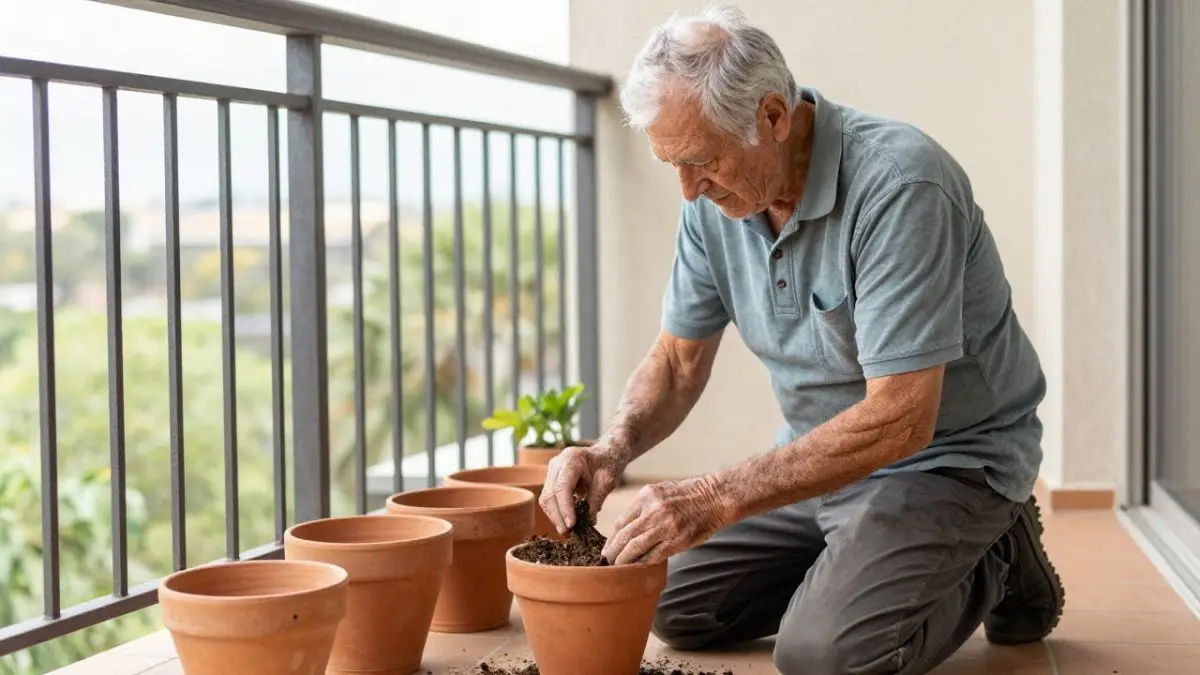
Starting small keeps the work manageable. Begin with three to five containers and one clear goal, such as a few herbs or a row of leafy greens.
Why Weight and Load Limits Matter on a Balcony
Wet potting mix is heavy. A 40 cm pot filled with moist mix can weigh well over 30 kg, and a row of them along a railing adds up quickly. The load needs to be spread rather than concentrated.
Check your strata or building rules before adding many large pots (Strata by-laws). If you are unsure, ask the building manager or owners corporation what the balcony is rated for. This is a practical check, not a reason to avoid gardening: most small herb and flower pots are well within normal limits, and the risk comes from clusters of large, wet containers in one spot.
Safe Container Placement
Keep the heaviest pots close to the wall or the structural edge of the balcony rather than out at the railing. Spread weight across the floor instead of stacking it in one corner.
Secure pots so wind cannot tip them over the railing. A pot on a railing ledge or a lightweight hanging basket in an exposed spot is a hazard in a gust. Use brackets rated for the load, keep hanging baskets inside the railing line, and avoid balancing pots on railings altogether.
Watch out: A pot that feels stable when dry can become top-heavy and unstable once watered, so test stability after watering, not before.
Choosing Pots, Containers and Planters That Drain Well
Good drainage matters more than the pot’s looks. Every container needs holes in the base so water can escape. Without them, roots sit in soggy soil and rot.
- Pick pots with at least one drainage hole
- Lift pots on small feet or pot risers so water can run away
- Use a saucer or tray to catch runoff, and empty it after rain
- Choose lighter containers, such as resin or fibreglass, if you’re concerned about weight
Watch out: Placing a pot in a saucer that stays full of water can drown the roots. Empty it within a few hours of watering.
Planning a Balcony Garden Layout That Makes Small Space Work
A balcony garden layout is about using every zone well. Think in layers: tall plants at the back or sides, medium plants in the middle, and trailing plants along the front.
Group plants with similar water and light needs together. That way you water once, not five times, and nothing gets too much sun or shade.
Using Vertical Space with Shelves, Wall Pots and Trellises
Going up saves floor space. Wall-mounted pots, tiered shelves and a simple trellis can hold several plants in the footprint of one.
- Use a sturdy tiered shelf for small pots of herbs
- Hang wall pots on rails where the wall can take the weight
- Train climbing beans or cucumbers up a trellis against a sunny wall
Check that any fixings are safe for your building before drilling into walls.
Vegetables to Grow in Pots on Your Balcony
Many vegetables grow well in containers, as long as the pot is deep enough. Root crops need depth, and fruiting plants need steady water and a sunny spot.
- Leafy greens: lettuce, kale and silverbeet grow quickly in shallow pots
- Root vegetables: carrots and beetroot need deep containers, at least 30 cm
- Fruiting plants: cherry tomatoes and capsicums like full sun and a large pot
- Compact varieties: choose dwarf or bush types for small spaces
Start with the leafy greens. They give quick results and build confidence.
Starting a Balcony Herb Garden You Can Harvest From
A balcony herb garden is one of the easiest wins. Basil, mint, parsley, chives and thyme all suit containers and can be picked often.
Mint spreads aggressively, so give it a pot of its own. Basil wants full sun and regular picking to stay bushy. Pinch off flower buds to keep the leaves coming.
Watering, Drainage and Feeding Your Plants Without Making a Mess
Container plants dry out faster than garden beds because a pot holds a small volume of mix and its sides warm up in the sun. The fix is not to water more often on a hunch, but to check the mix and water thoroughly when it is actually dry.
How Often to Water Balcony Pots
Push a finger into the mix up to the second knuckle. Find easier, less physically demanding watering and maintenance routines if bending and lifting is a concern. If it feels dry at that depth, water until it runs freely from the drainage holes. If it still feels cool and damp, wait a day. In warm weather, small pots may need water daily; larger pots and shade-tolerant plants may need it every two to three days. Hanging baskets and terracotta pots dry fastest because they lose moisture through the sides as well as the surface.
Water in the morning where possible. Evening watering leaves foliage damp overnight, which suits fungal problems, and midday watering on a hot day loses more to evaporation before the roots can take it up.
Drainage Holes, Saucers and Runoff
Every pot needs at least one drainage hole, and the hole must stay clear. A pot without holes holds a saturated layer at the base where roots suffocate and rot.
Saucers catch runoff but should not stay full. Empty them within a few hours of watering, and always after rain, so the pot is not sitting in water. On a balcony above ground level, runoff can drip onto neighbours below, so direct drainage into a tray rather than straight through the railing.
Watch out: A pot placed directly on a saucer that stays wet can develop root rot even when the top of the mix looks dry, because the base stays waterlogged.
Feeding Container Plants
Potting mix contains limited nutrients, and frequent watering leaches them out. Feed container plants every two to four weeks during the growing season with a liquid fertiliser mixed at the label rate. Leafy greens and herbs grown for foliage benefit from a nitrogen-leaning feed; fruiting plants such as tomatoes and capsicums need a feed higher in potassium once flowers set. Stop or reduce feeding in the cooler months when growth slows, because unused nutrients build up in the mix.
Refreshing Soil and Root-Bound Plants
After a season or two, potting mix compacts and roots fill the pot. Signs include water running straight through, roots circling the surface, and slowed growth despite feeding. Tip the plant out, tease the outer roots loose, and repot into a container one size larger with fresh potting mix. Trim away the oldest, woody roots if the root ball is dense. Refresh the top few centimetres of mix annually on plants you are not repotting, and remove any crust of fertiliser salts that forms at the surface.
The article’s key watering, drainage and feeding guidance, at a glance:
| Task | Timing or frequency | Key point |
|---|---|---|
| Check soil moisture | Push finger to second knuckle | Water only when dry at that depth |
| Water small pots in hot weather | Daily | Larger pots may need every two to three days |
| Empty saucers | Within a few hours of watering | Never leave pots standing in water |
| Feed container plants | Every two to four weeks | Use liquid fertiliser at label rate |
| Repot root-bound plants | After a season or two | Move up one pot size with fresh mix |
| Refresh surface mix | Annually | Remove crusted fertiliser salts |
Booking Your Spot in the Gardening Club Australia Community
Gardening is easier when you share it with others. Gardening Club Australia is an online community where members swap advice, show off their balconies and make new friends who share the same interest.
Membership costs $5 a month and includes access to experienced gardeners and member discounts on supplies. To learn what the community offers, read more about our online gardening community, and when you’re ready to sign up, join Gardening Club Australia today.
Frequently Asked Questions
How do I start a garden on a balcony?
Begin by checking how many hours of direct sun your balcony gets and where the wind hits hardest. Choose containers with drainage holes, fill them with a good potting mix, and start with two or three hardy plants that suit your light. Add more plants once you have learned how often your pots dry out. Gardening Club Australia members often share their own layouts, which can help you plan your first setup before you spend money on pots and soil.
What vegetables can I grow in pots on a balcony?
Many vegetables to grow in pots do well on balconies, including lettuce, radishes, silverbeet, cherry tomatoes, dwarf beans and spring onions. Leafy greens need less root depth and tolerate partial shade, while fruiting plants like tomatoes need at least six hours of sun. Choose compact or dwarf varieties where possible, as they suit pots and limited space. Pot size matters, so check the plant label for the minimum container depth before you buy.
How often should I water plants on a balcony?
Balcony pots dry out faster than garden beds, especially in summer wind and full sun, so check them daily during hot weather. Push a finger about 2 centimetres into the potting mix; if it feels dry, water until it runs out of the drainage holes. Use a saucer or tray to catch runoff, and empty it after watering so it does not stand in water. Water in the early morning where possible to reduce evaporation.
What size pots are best for balcony gardening?
For most herbs and salad greens, pots of 20 to 30 centimetres wide and deep are a practical starting point. Larger plants such as tomatoes or dwarf fruit trees need bigger containers, often 40 centimetres or more, which also hold more moisture. Heavy pots add load to the balcony, so check your building’s weight guidance before placing large soil-filled containers, and consider lightweight planters for upper levels.
